A cowboy named Bud was overseeing his herd in a remote mountainous pasture in California when suddenly a brand-new BMW advanced toward him out of a cloud of dust.
The driver, a young man in a Brioni suit, Gucci shoes, RayBan sunglasses and YSL tie, leaned out the window and asked the cowboy, "If I tell you exactly how many cows and calves you have in your herd, Will you give me a calf?"
Bud looks at the man, obviously a yuppie, then looks at his peacefully grazing herd and calmly answers, "Sure, Why not?"
The yuppie parks his car, whips out his Dell notebook computer, connects it to his Cingular RAZR V3 cell phone, and surfs to a NASA page on the Internet, where he calls up a GPS satellite to get an exact fix on his location which he then feeds to another NASA satellite that scans the area
in an ultra-high-resolution photo.
The young man then opens the digital photo in Adobe Photoshop and exports it to an image processing facility in Hamburg, Germany.
Within seconds, he receives an email on his Palm Pilot that the image has been processed and the data stored. He then accesses an MS-SQL database through an ODBC connected Excel spreadsheet with email on his Blackberry and, after a few minutes, receives a response.
Finally, he prints out a full-color, 150-page report on his hi-tech, miniaturized HP LaserJet printer, turns to the cowboy and says, "You have exactly 1,586 cows and calves."
"That's right. Well, I guess you can take one of my calves," says Bud.
He watches the young man select one of the animals and looks on with amusement as the young man stuffs it into the trunk of his car.
Then the Bud says to the young man, "Hey, if I can tell you exactly what your business is, will you give me back my calf?"
The young man thinks about it for a second and then says, "Okay, why not?"
"You're a Congressman for the U.S. Government", says Bud.
"Wow! That's correct," says the yuppie, "but how did you guess that?"
"No guessing required." answered the cowboy. "You showed up here even though nobody called you; you want to get paid for an answer I already knew, to a question I never asked. You used millions of dollars worth of equipment trying to show me how much smarter than me you are; and you don't know a thing about how working people make a living -- or about cows, for that matter.
This is a herd of sheep, now give me back my dog!
Thursday, July 16, 2009
Entertaining, and Yet, Takes No Effort
It's really easy to blog when you use other people's material. Courtesy of my friend Libby--who apparently got this joke from her brother:


Monday, July 13, 2009
Wednesday, July 8, 2009
Malcolm X and Capitalism
Over at Hit & Run, Damon Root dropped a little hate on intimated some unpleasant things about Malcolm X, a personal hero of mine:
As I noted in an earlier comment, what was touted as "capitalism" in Malcolm X's America was not a free market or an example of economic freedom. It was a nation governed, in part, by a racist minority in the Senate which simultaneously protected business interests and fought tooth and nail for the "Lost Cause." If that was capitalism*--I'd be vocally opposed to it as well.
Furthermore, it's hardly a secret that one of the major draws of blacks and other minorities into a socialist/communist fold was their (false) promise of racial equality. Socialists actively promoted their agenda by pointing out the racist, hypocritical policies of the U.S. and other "capitalist" countries--as if it were the capitalism itself that was racist. The unfortunate fact that Malcolm at least partially bought into this is, I believe, due to an ignorance of economic theory, not a preference for socialism. Indeed, in every speech I've read or heard of Malcolm's, he always referred to socialists in the third person. Free market theory means little to those who see business and government acting together to maintain a status quo which holds their people back by business practice, social custom, and law.
His pro-freedom message is very much borne out by the themes dominant in the majority of his speeches: personal responsibility, an inherent mistrust of the government, self-ownership and self-defense, the promises of (not actions under) the Constitution, and--most tellingly--black entrepreneurship. He couldn't have been clearer on the point that blacks should get into business: the "capitalism" of the day, however, shut many blacks out of starting private enterprises.
It is unfortunate and--I fully agree with Damon here--all too common for Malcolm to be hailed as a voice of the Left on college campuses. The facts, however, don't really bear out in this regard if you read and listen to what the man said and not rely on what is said about him.
*I think this is yet another case of conflating "business interests" and "market principles"--a businessman who benefits from/supports regulatory capture is hardly a free marketer; so too is it problematic to compare the "capitalists," as Malcolm understood them, with "classical liberals."
Rather than serving as the villains caricatured by Malcolm X, Manning Marable, and others on the left, classical liberals provided essential intellectual, political, moral, and financial firepower in the battles against slavery, Jim Crow, imperialism, and racial classifications.Now, as I put in the comments there, this may be less Damon's fault than of the historian Marable that he quoted at the beginning of his piece:
In a 1992 speech at Colorado's Metro State College, Columbia University historian Manning Marable praised the black minister and activist Malcolm X for pushing an "uncompromising program which was both antiracist and anticapitalist." As Marable favorably quoted from the former Nation of Islam leader: "You can't have racism without capitalism. If you find antiracists, usually they're socialists or their political philosophy is that of socialism."But one quote of Malcolm's does not sum up his political or economic philosophy. The fact that Malcolm wasn't familiar with free market theories and the protectionist anti-profit motive that supported segregation and other Jim Crow policies does not diminish his accomplishments as a proponent of civil and economic freedom for blacks.
As I noted in an earlier comment, what was touted as "capitalism" in Malcolm X's America was not a free market or an example of economic freedom. It was a nation governed, in part, by a racist minority in the Senate which simultaneously protected business interests and fought tooth and nail for the "Lost Cause." If that was capitalism*--I'd be vocally opposed to it as well.
Furthermore, it's hardly a secret that one of the major draws of blacks and other minorities into a socialist/communist fold was their (false) promise of racial equality. Socialists actively promoted their agenda by pointing out the racist, hypocritical policies of the U.S. and other "capitalist" countries--as if it were the capitalism itself that was racist. The unfortunate fact that Malcolm at least partially bought into this is, I believe, due to an ignorance of economic theory, not a preference for socialism. Indeed, in every speech I've read or heard of Malcolm's, he always referred to socialists in the third person. Free market theory means little to those who see business and government acting together to maintain a status quo which holds their people back by business practice, social custom, and law.
His pro-freedom message is very much borne out by the themes dominant in the majority of his speeches: personal responsibility, an inherent mistrust of the government, self-ownership and self-defense, the promises of (not actions under) the Constitution, and--most tellingly--black entrepreneurship. He couldn't have been clearer on the point that blacks should get into business: the "capitalism" of the day, however, shut many blacks out of starting private enterprises.
It is unfortunate and--I fully agree with Damon here--all too common for Malcolm to be hailed as a voice of the Left on college campuses. The facts, however, don't really bear out in this regard if you read and listen to what the man said and not rely on what is said about him.
*I think this is yet another case of conflating "business interests" and "market principles"--a businessman who benefits from/supports regulatory capture is hardly a free marketer; so too is it problematic to compare the "capitalists," as Malcolm understood them, with "classical liberals."
Tuesday, July 7, 2009
Quote of the Day
Mr Obama, so eloquent on a podium, speaks slowly and carefully in interviews, with frequent long pauses. This is obviously not because he is stupid or disfluent, but because he's hyper-aware of what a misstatement means in his job. Mr Biden, by contrast, is so keen to let you know that he knows all the provinces of Pakistan, that he is more likely than average to say something that will accidentally lead to nuclear war one day.
Economist "Democracy in America" blogger, New York
Monday, July 6, 2009
Mood Music Monday
I do apologize for the dearth of posts of late. I went on vacation, and since I've been back I've been playing a lot of catch-up, in addition to working on side-projects. I will try to get a few things up this week. In the meantime:
Monday, June 29, 2009
Mood Music Monday
The one major Michael hit not getting a whole lot of airplay:
Thus ends my MJ blogging.
Thus ends my MJ blogging.
Friday, June 26, 2009
Michael Jackson, RIP

I had originally wanted to start blogging again next week, but I feel compelled to say something about Michael Jackson's life and music as we head into what is certainly a perfect media storm of bullshit.
I heard that semi-literate, speech-impaired token named 'Sway' on MTV call Michael's death a "tragedy" yesterday. Perhaps, in addition to a much needed haircut, someone should get that brother a newspaper because no one with the depth of a rain puddle would call the (natural?) death of a 50 year old man with the influence, power, wealth and popularity Michael Jackson had a tragedy. In light of events



That said, I was admittedly saddened by his death.
Michael became a freakish embarrassment over the past 15-20 years and to those in Gen Y and after, I can fully understand their air of dismissal about his music and their surprise of the general reaction to his death. But anyone alive in the early 80s, at the pinnacle of his career, understands exactly how huge he was. He was a superstar of the highest order--he was, after all, simply "Michael."
Jokes about his skin-lightening and hair straightening aside, Michael was racially transcendent well before Barack Obama's candidacy brought in the pundits' half-assed search for words to describe a "post-racial America." People of all races knew and wore his red leather jacket, tried to emulate the moonwalk, and danced jubilantly to his songs. He was a musical ambassador to the world before Bono appointed himself the patron saint of musical philanthropy. There wasn't a politician, musical artist, or sports superstar who would refuse Michael anything. Put simply, whether some like to admit it today or not, Michael Jackson was indisputably the coolest man on Earth.
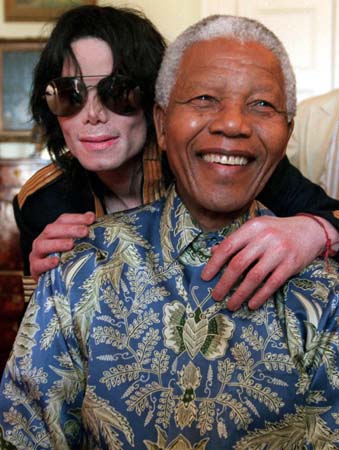


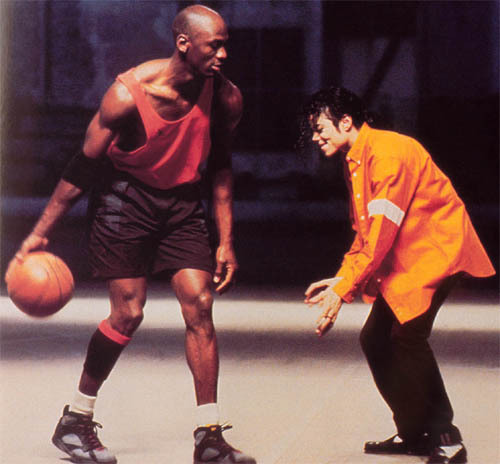
The allegations surrounding his more recent personal life are well-known and just add to the awfulness of what I believe Michael's image became--whether they were true or not. I think he was a tortured man, for reasons I never will understand and, as far as I'm concerned, those reasons died with him. The media circus that is already underway will be sickening to me and anyone else who fondly remembers what Michael used to be.
I was talking to a friend and mentor last night, via IM, who was most definitely touched by Michael's death. She said:
I get that it's silly to a lot of people and I know people think he was a bad person...[but] for him, the pain is over. But I think he was a beautiful soul and his music has brought me incredible amounts of joy, has moved me to tears, [and] has made be boogie my ass off.
Michael's music made my friend, me, and millions of others smile nearly any time one of his songs came on a radio or jukebox. To this day, I can barely keep from dancing when I listen to 'Billie Jean' or 'Beat it' or a half-dozen other songs that immediately bring back memories of my childhood and happy times.
I will choose to remember him as he was at the Motown 25 celebration when he debuted the Moonwalk, and am glad that now, at least, the media can't hound him anymore and he will finally be left alone.
RIP, Michael.
Subscribe to:
Posts (Atom)